

Most businesses spend the majority of their time and budget chasing new leads. However, growth does not stall because of a lack of leads — it stalls because relationships end too early.
When customers leave after one transaction, acquisition costs rise while lifetime value remains flat.
This is precisely why CRM customer relationships matter more than ever. A CRM is not just a place to store contacts or log deals.
Instead, it is the operational system that governs how relationships are built, nurtured, and expanded over time.
When used strategically, CRM customer relationships transform short-term conversions into long-term loyalty and predictable revenue.
In this guide, you will learn how to move from lead generation to customer loyalty by designing CRM customer relationships that support every stage of the customer lifecycle.
Understanding the Shift from Leads to Loyalty
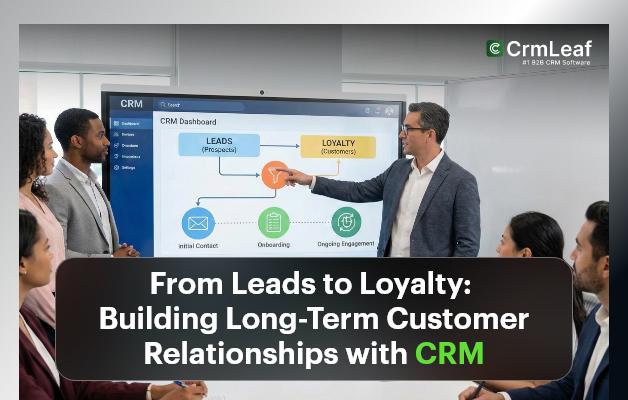
Traditionally, businesses view the customer journey as a straight line. A lead comes in, sales closes the deal, and the relationship effectively ends.
While this approach may generate short-term revenue, it fails to build long-term stability.
In contrast, CRM customer relationships are built on the understanding that value compounds over time.
Every interaction — marketing, sales, onboarding, support, and renewal — either strengthens or weakens the relationship.
Therefore, loyalty is not an outcome of chance; it is the result of intentional CRM design.
When organizations commit to CRM customer relationships, they stop treating customers as transactions and start treating them as long-term assets.
Why CRM Customer Relationships Drive Sustainable Growth
Modern buyers interact with brands across websites, emails, demos, support tickets, and renewal conversations.
Without a centralized system, these interactions remain fragmented, creating inconsistent experiences.
CRM customer relationships solve this problem by unifying customer data, context, and communication in one place.
As a result, teams gain visibility into the full customer journey rather than isolated touchpoints.
More importantly, CRM customer relationships allow businesses to anticipate needs instead of reacting to problems.
This proactive approach is what separates companies that retain customers from those that constantly replace them.
Capturing the Right Leads Inside Your CRM
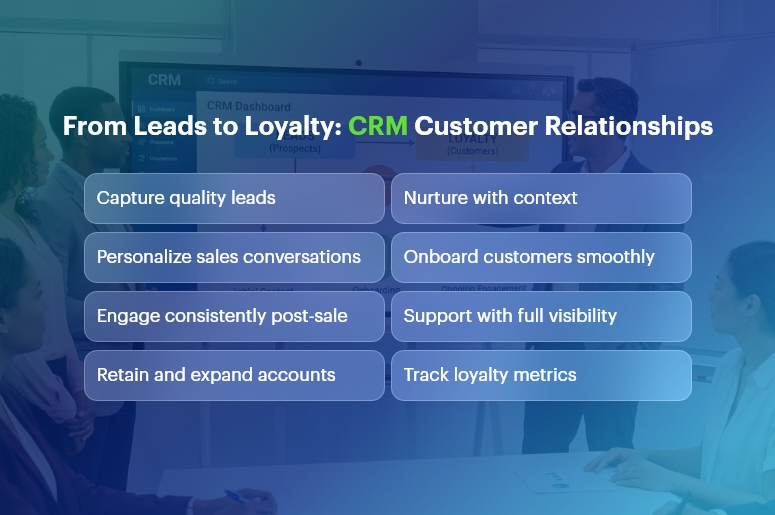
Strong CRM customer relationships begin with how leads enter the system.
When lead capture is disconnected or manual, critical context is lost before the first conversation even begins.
By integrating lead capture directly with your CRM, you ensure that every interaction starts with accurate, structured data.
This allows marketing and sales teams to act with clarity instead of assumptions.
Effective CRM-driven lead capture focuses on intent, source, and segmentation rather than volume.
As a result, the CRM becomes a system of intelligence, not just storage.
Nurturing Leads into Meaningful Relationships
Not every lead is ready to buy immediately.
Therefore, nurturing plays a critical role in building CRM customer relationships. However, nurturing should never feel generic or excessive.
A CRM enables contextual nurturing by tracking behavior, engagement history, and preferences.
This allows businesses to deliver timely, relevant communication that builds trust instead of noise.
Rather than pushing for immediate conversion, CRM customer relationships prioritize education, credibility, and consistency.
Over time, this approach shortens sales cycles and improves conversion quality.
Aligning Sales with CRM Customer Relationships
Sales conversations are most effective when they feel informed and personalized.
Customer relationships provide sales teams with a complete view of the customer’s journey, including prior interactions, content consumed, and expressed needs.
Because of this visibility, sales teams can lead conversations with relevance instead of repetition.
They ask better questions, present more accurate solutions, and close deals with less resistance.
When customer relationships guide sales behavior, the focus shifts from persuasion to problem-solving.
Onboarding as the Foundation of Loyalty
The post-sale phase is where many businesses lose momentum. Poor onboarding creates confusion, delays value realization, and increases churn risk.
CRM customer relationships address this challenge by structuring onboarding as a guided process rather than an ad hoc activity.
Automated workflows, task ownership, and milestone tracking ensure that customers experience early success.
A strong onboarding experience reinforces trust and sets the tone for a long-term relationship.
Sustaining Engagement Beyond the Sale
Customer relationships weaken when communication becomes reactive or sporadic.
Customer relationships prevent this by enabling ongoing, intentional engagement.
Through scheduled check-ins, lifecycle-based messaging, and usage insights, businesses can stay present without being intrusive.
Over time, customers begin to see the relationship as a partnership rather than a service transaction.
This consistency is what transforms satisfaction into loyalty.
The Role of CRM in Customer Support
Support interactions often define how customers remember a brand. When support operates in isolation, valuable relationship context disappears.
CRM customer relationships integrate support data with sales and marketing history, enabling faster resolution and more empathetic communication.
As a result, support teams respond with understanding rather than scripted answers.
When handled correctly, customer support becomes one of the strongest drivers of loyalty within CRM customer relationships.
Retention, Expansion, and Advocacy
True growth occurs after the initial sale. CRM customer relationships help businesses identify expansion opportunities while reducing churn risk.
By analyzing engagement patterns and satisfaction indicators, organizations can proactively address concerns and introduce relevant upgrades.
Over time, loyal customers become advocates who generate referrals and social proof.
This is where CRM customer relationships create exponential value.
Key Metrics That Reflect Relationship Health
To succeed long term, CRM performance must be measured beyond activity counts. Relationship health requires deeper insight.
Focus on metrics such as:
- Customer Lifetime Value (CLV)
- Retention and churn rates
- Engagement frequency across lifecycle stages
- Net Revenue Retention (NRR)
These indicators reveal whether customer relationships are strengthening or deteriorating over time.
Common Pitfalls That Undermine CRM Customer Relationships
Many CRM initiatives fail not because of technology, but because of poor strategy and adoption.
Treating CRM as a reporting tool, neglecting data quality, or automating without personalization weakens relationships instead of strengthening them.
Avoiding these mistakes ensures that CRM relationships remain authentic, scalable, and effective.
CRM as a Long-Term Business Asset
Ultimately, customer relationships are not about software implementation. They are about operational discipline and customer-centric thinking.
When CRM is aligned with the customer journey, it becomes a growth engine that compounds value across every department. Instead of constantly chasing new leads, businesses build loyalty, predictability, and trust.
That is the difference between short-term wins and sustainable success.
FAQs
1. What are CRM customer relationships?
Customer relationships refer to how businesses manage, nurture, and grow customer interactions across the entire lifecycle — using CRM systems to centralize data, personalize engagement, and build long-term loyalty.
2. How does a CRM help turn leads into loyal customers?
A CRM helps turn leads into loyal customers by capturing lead data, enabling contextual nurturing, supporting personalized sales conversations, and sustaining post-sale engagement through structured workflows.
3. Why are customer relationships important for long-term growth?
CRM customer relationships are important because they reduce churn, increase customer lifetime value, and create predictable revenue by focusing on retention and relationship-building instead of one-time sales.
4. Can small businesses benefit from customer relationships?
Yes. Small businesses benefit significantly from customer relationships because CRMs help automate follow-ups, organize customer data, and deliver consistent experiences without increasing manual effort.
5. How does CRM improve lead nurturing effectiveness?
CRM improves lead nurturing by tracking behavior, engagement history, and preferences, allowing businesses to send timely, relevant communication instead of generic messages.
6. What role does CRM play after a customer makes a purchase?
After purchase, customer relationships support onboarding, ongoing engagement, customer support, renewals, and upsell opportunities—ensuring the relationship continues to grow.
7. How does CRM support customer retention and expansion?
CRM customer relationships help identify churn risks, track satisfaction signals, and uncover expansion opportunities through data-driven insights and proactive engagement.
8. What metrics should be tracked to measure customer relationships?
Key metrics include Customer Lifetime Value (CLV), retention rate, churn rate, engagement frequency, and Net Revenue Retention (NRR), as these reflect relationship health over time.
9. What are common mistakes that weaken customer relationships?
Common mistakes include treating CRM as a contact database, poor data quality, lack of user adoption, and excessive automation without personalization.
10. Is CRM customer relationship management about software or strategy?
CRM are primarily about strategy. The software supports execution, but long-term success depends on customer-centric processes, disciplined operations, and lifecycle alignment.